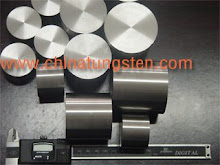
Applications which might gain more importance in the future are Construction material for the plasma chamber in magnetohydrodynamic power generation (W and W-Cu) and target plates in fusion reactors (W, W-La2O3).
Recent plasma experiments and theoretical and numerical studies show that tungsten may be the best, if not the only, material to withstand the extraordinary operating conditions in a nuclear fusion reactor divertor. The divertor, being that part of the vacuum vessel where the plasma particles interact with the first wall, and where a large fraction of the fusion heat is removed, consists of water-cooled copper heat-exchanger element covered with a plasma facing armor. The plasma particles (electrons, protons, and α-particles) are directed by the magnetic field toward the divertor target plates, where they are neutralized and pumped. The convective heat flux reaches 20 MW.m-2 and the attendant surface temperature more than 3000℃. Therefore, a suitable armor material must have a high thermal conductivity (in order to transfer high heat fluxes), low thermal expansion coefficient and low Young’s modulus (in order to keep thermal stresses low), and a high melting point and low sputtering yield (in order to keep erosion low). Although tungsten does not have as high a thermal conductivity and as low a Young’s modulus as carbon-carbon composite materials, which are foreseen for the sections of the divertor with the highest heat flux, many experts believe that, in the long run, reasonable lifetimes will only be achieved by tungsten divertor plates, which have the lowest erosion rates of all materials in sections of the divertor with relatively low plasma temperature but high particle density.
Low-pressure plasma technique
For the technical realization of low-pressure plasma processes, one requires equipment with the following components:
vacuum system (pump, vessel)
energy supply
gas supply
measurement and control components for the reproducible adjustment of the process parameter
Due to the necessity of a vacuum system in most cases, batch operation method is the easiest solution. The processes can be flexibly and complexly configured, in order to change the mode of action of the plasma through variation of the process parameters (pressure, gas flow, gas composition, power) and can attain different effects in one process step. So that, i.e. without great expenditure a secondary cleaning can be carried out and immediately thereafter a corrosion protection layer becomes deposited, without having to aerate in between.
Further advantages of low-pressure plasma technique:
ability of fissure-penetration by the plasma: even most complex sample geometries up to porous substrates can be treated
no thermal or mechanical strain of the substrates
high measure on environmental compatibility and operational safety
Chinatungsten has diverse facilities available for the various concepted questions (bulk material, batch goods, rail goods, size of the reactor up to 3m 3, MHz- and GHz stimulation); as well as many years of experience in the development of plasma processes and the conception of applicative plasma devices up to pilot graduations.
Within the bounds of its function as service provider in technology transfer, we offer its resources for the processing of the above-mentioned industrial questions up to series production. Our service comprises consultation, process development, sampling and industrial installation through pilot terotechnology.
Plasma Treatment – endless possibilities
Plasma can be used in many different cases whenever you would like to better adhere materials together or to change a surface property to suit your needs. With this trend-setting technology it is possible to modify virtually any surface. Plasma technology offers several versatile applications, for example:
Cleaning surfaces of any residues, oils, or contamination
Activation of various materials before gluing, painting, etc.
Etching and partial removal of surfaces
Coating of parts with several possible types of layers (PTFE-like, protective barriers, hydrophobic, hydrophilic, friction-reducing, etc.)
Plasma technology is establishing itself in all areas of industry, and new applications are constantly evolving.
Plasma Technology - Convincing Advantages
Compared to other methods, like flame treating or using chemicals to treat a surface, plasma technology exhibits many important advantages:
Many surface properties can be obtained exclusively with this procedure
Can be used in online production or operated independently
nvironmentally friendly process
Regardless of geometry you are able to treat powder, small parts, discs, fleece, textiles, tubing, bottles, circuit boards, etc.
Fabricated parts will not be mechanically changed
Heating of the parts is minimal
Operating costs are very low
Extremely safe to operate
Process is extremely energy efficient
Tungsten alloy is a suitable material for construction parts for plasma technique/ion propulsion. So if you have any interest in this product, please feel free to email us: sales@chinatungsten.com or call us by: 0086 592 512 9696, 0086 592 512 9595.
Felicity
Thursday, 22 April 2010


Combustion Chamber of Turbo Engines
What is Turbo Engines?
As we know, turbo engine is the heat engine which is conditioned by their maximum intake temperature, and it is limited by the behavior of the constituent materials of the articles that are most exposed to heat and constraints.
Why choose tungsten alloy?
Concerns for environmental protection have led designers of aviation turbo engines to search for means to reduce the proportion of pollutants in the exhaust gases of the engines. It is known that the principal problems in the matter of pollution of aviation turbo engines are, on the one hand, the emission of carbon monoxide, of hydrocarbons, and of various unburnt residues during operation on the ground and, on the other hand, the emission of nitrogen oxides and of particles during take-off and during cruising at altitude. There fore, tungsten alloy products are increasingly accepted by public in this case.
Conventional combustion chambers are generally of optimized rating for take-off or near take-off operation. This signifies that, in the primary zone of the combustion chamber, a fraction of the air flow of the compressor is introduced so that, with the injected fuel, the fuel-air mixture in this zone would be essentially stoichiometric in these modes. Under these conditions, due to the levels of temperature and high pressures, as complete as possible a combustion is obtained, combustion yields greater than 0.99 are attained, the speeds of the chemical reaction being optimum for these stoichimoetric mixtures.
In contrast, at low ratings, at idle or nearly so, the total richness in the chamber is only about half that at take-off; in addition, the pressures and temperatures at the outlet of the compressor are lower; the result is that the chamber, with the partial charge is very much maladjusted and that the slow speed combustion efficiency rarely goes beyond 0.93. The combustion is, therefore, very incomplete, which means much higher concentrations of carbon monoxide and unburnt residues at the exhaust than under normal operation. The proportions of the pollutants are all the higher, the lower the total yield of the combustion.
However, it appears to be possible to improve the performance of a combustion chamber by acting on four factors:
The timing of vaporization of the fuel,
The timing of the air-fuel mixture,
The timing of the fresh gas/burnt gas mixture,
The timing of the chemical reaction.
The first two times can be considered negligible at high ratings because of the pressures which are attained, but it is not so at low ratings. In fact, in order to increase the speed of the vaporization of the fuel, it must be transformed into fine droplets, which, in normal operation, is easily realized by the conventional mechanical atomizing injector, but the performance which is obtained in the lower ratings is poor. This is due to the fact that, if the fuel is well divided into droplets, these are poorly mixed with air in the primary zone and local zones would appear which have a richness which is too high. In the end, it would be necessary that each droplet would have around it the quantity of gas necessary for its vaporization and for its combustion, i.e., a quantity of gas which results in a stoichiometric mixture with the oxygen molecules after complete varporization. In order to accomplish this, systems such as aerodynamic injection have been proposed. Aerodynamic type injectors generally comprise whirling, or swirler vanes through which the air from the compressor is introduced, which serves to atomize the fuel. An air/fuel pre-mixture is thus obtained.
The fresh gas/burnt gas mixture must also be advantageous because it contributes to the increase in the temperature of the carburized mixture and, therefore, aids in its atomization and consequently permits an improvement in the speed of the chemical reaction. In conventionally allowing this contact of the carburized mixture with the high temperature gas from the combustion it is desirable to arrange for a recirculation of the latter by searching for a convenient turbulence level.
All of these solutions, which allow an improvement in the combustion yield have, however, a maximum efficiency only for values sufficient for the pressures and temperatures of the air at the chamber inlet.
As far as the reaction time is concerned, it is necessary to additionally research an optimization of the richness of the mixture, the ideal would be to be able to obtain a stoichiometric air/fuel proportion in the flame stabilization zone, regardless of the operation of the engine.
A first objective of this product is to provide a novel solution to the problem of low operating combustion for a chamber which includes aerodynamic type or pre-atomization injectors, which are mounted in the base of the chamber. In fact, in the case of a conventional chamber of this type, which is arranged to provide a stoichiometric mixture at take-off, about one-third of the air flow necessary for the combustion is introduced in the injection system and two-thirds by the primary orifices.
All of these factors are advantageous for a reduction of the reaction times and could lead to a reduction of the length of the combustion chamber and thus to a limitation of the dwell time of the gases in the latter.
As far as the chambers of the annular or nozzle-shaped type are concerned, it is possible to design the intermediate segment in the form of an annular zone which is common to all the injectors. The intermediate segment would then be formed of a circular base located in a plane which is perpendicular to the axis of the chamber to which the injectors are attached, and of two annular lateral walls which are welded, at the one end, to the circular base and on the other end to the base of the chamber, defining an annular volume which flares towards downstream, various forms could be adapted for the lateral walls, in a manner analogous to the case of the intermediate segment itself to each injector. They could each particularly be generated by a straight line and then each form a conic wall at the downstream end on which the holes, which are designed for the introduction of the fourth flow of air are located, distributed over one or several circles which are located on one or several planes which are perpendicular to the axis of the chamber. Each of the lateral walls could be formed of two truncated conical sections, with the connecting axes welded end to end, of which the angles at the top increase towards downstream, the small diameter holes which are designed for the injection of the fourth air flow being located immediately ahead of the joint which is formed by the joining of the two truncated cones, and distributed over one or several planes which are perpendicular to the common axis of the truncated cones. They could also be formed of a first truncated portion, with a top angle between 60° and 100°, comprising, at its downstream end, an annular zone which is located in a plane which is perpendicular to the axis of the chamber, in which the small diameter holes are drilled, which are designed for the injection of the fourth air flow, the holes being distributed over one or several circles which are coaxial with the said zone and having their axis normal to the generators of the truncated portion, to which an annular zone is joined where they are drilled. This last arrangement proves to be particularly advantageous in the case of a high performance chamber because of the fact that it suppresses the hot slip-streams behind the jets which correspond to the fourth flow.
The diameter of the holes, which are designed for the injection of the fourth flow, in the intermediate annular segment, which will represent 1/6 to 1/3 of the primary air, will have a diameter between 1/10 and 1/40 of the maximum dimension of the flared segment, measured on a radius of the chamber.
The cooling of the downstream ends of each lateral wall by a fifth air flow obviously works, the holes which are designed for the injection of this fifth flow being located in the immediate proximity of the joint between each lateral wall and the chamber, the values of the angles and the flow being identical to that mentioned in the case of the chambers for which each injector possesses its own intermediate segment.
The penetration of the intermediate segment could also be realized in order to increase the volume of the secondary recirculation zone; its depth of penetration will then be between one-fifth and one-half of the maximum dimensions of the intermediate segment, measured on a radius of the chamber.
Chinatungsten can offer tungsten alloy products used in this case not only according to international standard, but also as per customer’s requirements. Tungsten alloy is a suitable material for combustion chamber of turbo engines. So if you have any interest in this product, please feel free to email us: sales@chinatungsten.com or call us by: 0086 592 512 9696, 0086 592 512 9595. We are at your service.
Felicity
As we know, turbo engine is the heat engine which is conditioned by their maximum intake temperature, and it is limited by the behavior of the constituent materials of the articles that are most exposed to heat and constraints.
Why choose tungsten alloy?
Concerns for environmental protection have led designers of aviation turbo engines to search for means to reduce the proportion of pollutants in the exhaust gases of the engines. It is known that the principal problems in the matter of pollution of aviation turbo engines are, on the one hand, the emission of carbon monoxide, of hydrocarbons, and of various unburnt residues during operation on the ground and, on the other hand, the emission of nitrogen oxides and of particles during take-off and during cruising at altitude. There fore, tungsten alloy products are increasingly accepted by public in this case.
Conventional combustion chambers are generally of optimized rating for take-off or near take-off operation. This signifies that, in the primary zone of the combustion chamber, a fraction of the air flow of the compressor is introduced so that, with the injected fuel, the fuel-air mixture in this zone would be essentially stoichiometric in these modes. Under these conditions, due to the levels of temperature and high pressures, as complete as possible a combustion is obtained, combustion yields greater than 0.99 are attained, the speeds of the chemical reaction being optimum for these stoichimoetric mixtures.
In contrast, at low ratings, at idle or nearly so, the total richness in the chamber is only about half that at take-off; in addition, the pressures and temperatures at the outlet of the compressor are lower; the result is that the chamber, with the partial charge is very much maladjusted and that the slow speed combustion efficiency rarely goes beyond 0.93. The combustion is, therefore, very incomplete, which means much higher concentrations of carbon monoxide and unburnt residues at the exhaust than under normal operation. The proportions of the pollutants are all the higher, the lower the total yield of the combustion.
However, it appears to be possible to improve the performance of a combustion chamber by acting on four factors:
The timing of vaporization of the fuel,
The timing of the air-fuel mixture,
The timing of the fresh gas/burnt gas mixture,
The timing of the chemical reaction.
The first two times can be considered negligible at high ratings because of the pressures which are attained, but it is not so at low ratings. In fact, in order to increase the speed of the vaporization of the fuel, it must be transformed into fine droplets, which, in normal operation, is easily realized by the conventional mechanical atomizing injector, but the performance which is obtained in the lower ratings is poor. This is due to the fact that, if the fuel is well divided into droplets, these are poorly mixed with air in the primary zone and local zones would appear which have a richness which is too high. In the end, it would be necessary that each droplet would have around it the quantity of gas necessary for its vaporization and for its combustion, i.e., a quantity of gas which results in a stoichiometric mixture with the oxygen molecules after complete varporization. In order to accomplish this, systems such as aerodynamic injection have been proposed. Aerodynamic type injectors generally comprise whirling, or swirler vanes through which the air from the compressor is introduced, which serves to atomize the fuel. An air/fuel pre-mixture is thus obtained.
The fresh gas/burnt gas mixture must also be advantageous because it contributes to the increase in the temperature of the carburized mixture and, therefore, aids in its atomization and consequently permits an improvement in the speed of the chemical reaction. In conventionally allowing this contact of the carburized mixture with the high temperature gas from the combustion it is desirable to arrange for a recirculation of the latter by searching for a convenient turbulence level.
All of these solutions, which allow an improvement in the combustion yield have, however, a maximum efficiency only for values sufficient for the pressures and temperatures of the air at the chamber inlet.
As far as the reaction time is concerned, it is necessary to additionally research an optimization of the richness of the mixture, the ideal would be to be able to obtain a stoichiometric air/fuel proportion in the flame stabilization zone, regardless of the operation of the engine.
A first objective of this product is to provide a novel solution to the problem of low operating combustion for a chamber which includes aerodynamic type or pre-atomization injectors, which are mounted in the base of the chamber. In fact, in the case of a conventional chamber of this type, which is arranged to provide a stoichiometric mixture at take-off, about one-third of the air flow necessary for the combustion is introduced in the injection system and two-thirds by the primary orifices.
All of these factors are advantageous for a reduction of the reaction times and could lead to a reduction of the length of the combustion chamber and thus to a limitation of the dwell time of the gases in the latter.
As far as the chambers of the annular or nozzle-shaped type are concerned, it is possible to design the intermediate segment in the form of an annular zone which is common to all the injectors. The intermediate segment would then be formed of a circular base located in a plane which is perpendicular to the axis of the chamber to which the injectors are attached, and of two annular lateral walls which are welded, at the one end, to the circular base and on the other end to the base of the chamber, defining an annular volume which flares towards downstream, various forms could be adapted for the lateral walls, in a manner analogous to the case of the intermediate segment itself to each injector. They could each particularly be generated by a straight line and then each form a conic wall at the downstream end on which the holes, which are designed for the introduction of the fourth flow of air are located, distributed over one or several circles which are located on one or several planes which are perpendicular to the axis of the chamber. Each of the lateral walls could be formed of two truncated conical sections, with the connecting axes welded end to end, of which the angles at the top increase towards downstream, the small diameter holes which are designed for the injection of the fourth air flow being located immediately ahead of the joint which is formed by the joining of the two truncated cones, and distributed over one or several planes which are perpendicular to the common axis of the truncated cones. They could also be formed of a first truncated portion, with a top angle between 60° and 100°, comprising, at its downstream end, an annular zone which is located in a plane which is perpendicular to the axis of the chamber, in which the small diameter holes are drilled, which are designed for the injection of the fourth air flow, the holes being distributed over one or several circles which are coaxial with the said zone and having their axis normal to the generators of the truncated portion, to which an annular zone is joined where they are drilled. This last arrangement proves to be particularly advantageous in the case of a high performance chamber because of the fact that it suppresses the hot slip-streams behind the jets which correspond to the fourth flow.
The diameter of the holes, which are designed for the injection of the fourth flow, in the intermediate annular segment, which will represent 1/6 to 1/3 of the primary air, will have a diameter between 1/10 and 1/40 of the maximum dimension of the flared segment, measured on a radius of the chamber.
The cooling of the downstream ends of each lateral wall by a fifth air flow obviously works, the holes which are designed for the injection of this fifth flow being located in the immediate proximity of the joint between each lateral wall and the chamber, the values of the angles and the flow being identical to that mentioned in the case of the chambers for which each injector possesses its own intermediate segment.
The penetration of the intermediate segment could also be realized in order to increase the volume of the secondary recirculation zone; its depth of penetration will then be between one-fifth and one-half of the maximum dimensions of the intermediate segment, measured on a radius of the chamber.
Chinatungsten can offer tungsten alloy products used in this case not only according to international standard, but also as per customer’s requirements. Tungsten alloy is a suitable material for combustion chamber of turbo engines. So if you have any interest in this product, please feel free to email us: sales@chinatungsten.com or call us by: 0086 592 512 9696, 0086 592 512 9595. We are at your service.
Felicity
Actuator in Self-winding Watches

What is actuator in self-winding watches?
An automatic or self-winding watch is a mechanical watch, whose mainspring is wound automatically by the natural motion of the wearer's arm, to make it unnecessary to manually wind the watch. Most mechanical watches sold today are self-winding.
(you can see more details in http://en.wikipedia.org/wiki/Automatic_watch)
How it works?
The mechanism of most automatic watch movement is based on the hand-winding mechanical watch movement.
To become automatic, the watch contains a semicircular 'rotor', an eccentric weight that turns on a pivot, within the watch case. The normal movements of the user's arm and wrist cause the rotor to pivot back-and-forth on its staff, which is attached to a ratcheted winding mechanism. The motion of the wearer's arm is thereby translated into the circular motion of the rotor that, through a series of reverser and reducing gears, eventually winds the mainspring. Modern self-winding mechanisms have two ratchets and wind the mainspring during both clockwise and counterclockwise rotor motions.
The fully-wound mainspring in a typical watch can store enough energy reserve for roughly two days, allowing automatics to keep running through the night while off the wrist. Usually automatic watches can also be wound manually by turning the crown, so the watch can be kept running when not worn, and in case the wearer's wrist motions are not sufficient to keep it wound automatically.
In it, tungsten alloy is a very important component. So if you have any interest in this product, please feel free to email us: sales@chinatungsten.com or call us by: 0086 592 512 9696, 0086 592 512 9595.
Felicity
Monday, 19 April 2010
Syringe Shield


Syringe Shield 3cc:
Introduction:
9 mm thick glass-5.2g/cc gives optimum protection and is easily replaced. Fully exposed needle hub allows you to visually check for correct venous insertion prior to injection.
Weight: Without glass:
2.5cc: 0.3 lbs (0.14kg)
3cc: 0.36 lbs (0.16kg)
5cc: 0.4 2bs (0.19kg)
10cc: 0.62 lbs (0.28kg)
With glass:
3cc: 0.42 lbs (0.19kg)
5cc: 0.53 lbs (0.24kg)
10cc: 0.77 lbs (0.35kg)
Drawing Syringe Shield 3cc
Introduction:
2 mm solid tungsten flange helps shield the hand when withdrawing liquid from a vial. Flange is easily removed to allow transition from drawing dose to patient injection. 9 mm thick glass-5.2g/cc gives the greatest protection of any glass in any syringe shield and is easily replaced. twist-turn and the syringe is held firmly.
Material: tungsten
Weight:
3cc: 0.77 lbs (0.35kg)
5cc: 1.06 lbs (0.48kg)
10cc: 1.5 lbs (0.68kg)
PETPig Syringe Pig/Syringe Shield
PETPig permits the safe transport and administration of unit dose PET radiopharmaceuticals. The “T”handle on the PETPig cap allows the unit to be easily lifted out of traditional “ammo can” delivery cases. The use of the thermos style handle reduces hand exposure by permitting the PETPig to be carried to the imaging suite without holding container sidewalls. Prior to injection, the base unscrews, allowing the center portion to be used as a syringe shield. When placed in the optional PETPig Cradle, patient administrations can be performed with ease and maximum shielding.
Weight: 15.6 lbs
PET Dispensing System Syringe Shield 3/5 cc
The PET Syringe Shield magnetically docks with the PET Dispensing Pig .Designed to accept 3cc and 5cc B-D syringes ,it places the needle inside the vial septum when engaged . The external calibration rod allows the precise volume to be withdrawn without a leaded glass viewing port ,where high exposure levels cannot be adequately shielded .
Sunday, 18 April 2010
X-ray target & collimator
X-ray Target
X-ray target can be subjected to higher loadings than stationary anodes. By rotation of dish-shaped X-ray targets under the electron beam, a new, already cooled part of the target surface is continually used as the focal spot. Moreover, the X-ray target cools down more rapidly by radiating its heat. Far more energy per unit time can therefore be supplied to an X-ray tube with an X-ray target in comparison with a stationary anode.
Multi leaf collimator
Radiotherapy destroys cancer by directing beams of radiation directly onto the tumor. The beams of radiation require a very fine focus to avoid harming the surrounding healthy tissue. This focus is achieved by using a multi-leaf collimator, consisting of two rows of very thin tungsten alloy plates, which can be configured to exactly match the dimensions of the tumor.
Collimators and shielding made of tungsten heavy alloy groundbreaking components in the medical industry. They contribute significantly to successful radiotherapy through their high density and high shielding capability against X-rays and gamma rays.
Tungsten Alloy Counterbalance /Counterweight
Tungsten Alloy Counterbalance /Counterweight
Tungsten alloy Counterbalance weight is used in applications such as yacht, sailboat, submarine and other vessels crank camshafts, holders for Well Logging, Racing Weights. vibration damping and dynamic balancing.
The high density and metallurgical properties found in tungsten heavy alloys make it an excellent casing material for down hole logging of oil wells. ATI Firth Sterling has years of experience in producing high properties in large bars of class 1, 2, or 3 material. ATI Firth Sterling can supply Densalloy™ in pressed & sintered blanks large enough to yield the desired component or machined components to customer’s specifications.
Geologging
Geologging is an exploration technique used mainly in the oil and gas industries. It is also known as wireline logging and borehole logging. A gamma ray source is lowered into a borehole and the radiation penetrates the rock strata. This data can then be analysed to determine whether deposits of gas or oil are present. tungsten alloy is used to shield the radioactive source and to act as a collimator for the gamma beam.
  |  |
 | |
 |  |
Balls: φ 2mm above
Shafts: (φ2mm above)×(Length max.600mm)
Sheets: (Thickness 0.15mm above) ×(Wideness max.200mm)×(Length max.500mm)
Square, round and rectangle sizes: diameter 550mm above
According the demanding
Tungsten Heavy Alloy (WHA) in Aerospace
Tungsten Heavy Alloy (WHA) in Aerospace
Tungsten alloys are generally used by aerospace designers for balancing components or reducing vibration. The high density of tungsten materials allows maximum sensitivity from optimum mass and is particularly valuable in situations where a large mass has to be contained in a confined space.
Examples of applications
| Trim Weights Anti-Flutter Weights Flight control surfaces
Anti-Vibration Weights
Rotor Blades
Propeller Blades
Inertial Systems
Ballast Weights
Dimensions: | |


Tungsten Heavy Alloy (WHA) Ordnance Components
Tungsten Heavy Alloy (WHA) Ordnance Components
Since the World War II, tungsten alloys have proven their worth in ordnance applications. Hyper-velocity armor-penetrating applications use our materials in spheres, cubes, and projectile shapes。
Manufacturing techniques and additives allow us to vary certain properties, such as elongation, ultimate tensile strength, and hardness, of our tungsten alloys in order to meet your needs.
 |  |
 |  |
 |  |
 |
Dimensions:
Balls: φ 2mm above
Shafts: (φ2mm above)×(Length max.600mm)
Sheets: (Thickness 0.15mm above) ×(Wideness max.200mm)×(Length max.500mm)
Square, round and rectangle sizes: diameter 550mm above
According the demanding
Tungsten Heavy Alloy (WHA) Geological and Non Destructive Testing (NDT)
Tungsten Heavy Alloy (WHA) Geological and Non Destructive Testing (NDT)
Tungsten alloy is used as collimator or radiation shielding in the following applications:
Geologging is an exploration technique used mainly in the oil and gas industries. It is also known as wireline logging and borehole logging. A gamma ray source is lowered into a borehole and the radiation penetrates the rock strata. This data can then be analysed to determine whether deposits of gas or oil are present. tungsten alloy is used to shield the radioactive source and to act as a collimator for the gamma beam.
Pipe-line inspection
Gamma radiation is used to inspect welds and to detect cracks in pipelines. A gamma source is mounted on a remote-controlled wheeled trolley (sometimes called a "pig") and travels inside the length of the pipe. A Ttungsten collimator is used to direct the radiation onto the target, whilst the radioactive source is housed inside tungsten shielding.
Industrial radiography uses gamma radiation to detect structural faults in materials such as metal and concrete. As with pipe-line inspection, the equipment uses tungsten shielding, coupled with a WOLFMET tungsten collimator.
Thickness, density and level gauging Radioactive sources are used in industrial processes to measure thickness, density or levels of materials during production e.g. paper, plastic film, steel sheet or surface coatings. The material passes between a radioactive source, which is housed in WOLFMET tungsten alloy, and a detector. The strength of the detector signal is used to measure the thickness, density or level of the material.
Homeland Security and Border Control
The penetrating power of radiation has also been put to use in the fight against terrorism. The Homeland Security industry has designed scanners that use gamma radiation to detect objects in cargo containers or airline baggage.
The radioactive sources are very strong and require Chinatungsten's tungsten shielding to protect security staff and members of the public from the radiation. A tungsten collimator is also required to direct the gamma radiation onto its target
Dimensions
Balls: φ 1.5mm -φ 100mm
Shafts: (φ1mm above)×(Length max.600mm)
Sheets: (Thickness 0.15mm above)×(Wideness max.200mm)×(Length max.500mm)
Square, round and rectangle sizes: diameter 550mm above
According the demanding
Tungsten Heavy Alloy(WHA) Nuclear Medical Radiation Shielding
Tungsten Heavy Alloy(WHA) Nuclear Medical Radiation Shielding
Tungsten alloy is ideal for shielding against X rays and gamma radiation. The very high density of tungsten shielding (more than 60% denser than lead) allows a reduction in the physical size of shielding components, without compromising their rigidity or the effectiveness of the shielding characteristics.
Tungsten heavy alloy shielding is used in applications such as collimator, nuclear shielding, beamstop, PET syringe shield, vial shield, isotope container, FDG container, multi leaf collimator etc.
 |  |
 |  |
 |  |
Positron Emission Tomography (PET)
Positron emission tomography (PET) is one of the nuclear medicine techniques available for diagnosis. Whilst X-rays provide information on the structure of the body, PET shows the chemical function of a particular organism. PET involves the injection of FDG (a glucose-based radionuclide) from a shielded syringe into the patient. As the FDG travels through the patient’s body it emits gamma radiation which is detected by a gamma camera, from which the chemical activity within cells and organs can be seen. Any abnormal chemical activity may be a sign that tumours are present.
PET scans are frequently used to detect cancerous tumours and diseases of the brain and coronary arteries.
Applications for tungsten alloy shielding in PET include:
| | PET syringe shield |
| | Tungsten vial shield |
| | Tungsten FDG transport container |
| | Collimator for gamma camera |
| | Technetium generator |
 |  |
Multi leaf Collimator
Radiotherapy destroys cancer by directing beams of radiation directly onto the tumour. The beams of radiation require a very fine focus to avoid harming the surrounding healthy tissue. This focus is achieved by using a multi-leaf collimator , consisting of two rows of very thin tungsten alloy plates, which can be configured to exactly match the dimensions of the tumour.
Dimensions:
Balls: Φ2mm above
Shafts: (Φ2mm above)×(Length max.600mm)
Sheets: (Thickness 0.15mm above)×(Wideness max.200mm)×(Length max.500mm)
Square, round and rectangle sizes: diameter 550mm above
According the demanding
Tungsten Heavy Alloy(WHA) Nuclear Research Radiation Shielding
Tungsten Heavy Alloy(WHA) Nuclear Research Radiation Shielding
Nuclear research establishments use nuclear reactors or cyclotrons to study or create radioactive materials. tungsten alloy is used in research activities as collimators (devices which guide or focus beams of radiation) or containers for radioactive isotopes. tungsten alloy is ideal for shielding against both X- and Gamma radiation. The very high density of tungsten shielding (more than 60% denser than lead) allows a reduction in the physical size of shielding components, without compromising the effectiveness of the shielding characteristics.
  | |
| | |
  | |
GEOLOGGING & NON DESTRCIVE TESTING (NDT)
Tungsten alloy is used as collimator or radiation shielding in the following applications:
Geologging
Geologging is an exploration technique used mainly in the oil and gas industries. It is also known as wireline logging and borehole logging. A gamma ray source is lowered into a borehole and the radiation penetrates the rock strata. This data can then be analysed to determine whether deposits of gas or oil are present. tungsten alloy is used to shield the radioactive source and to act as a collimator for the gamma beam.
Pipe-line inspectionGamma
Radiation is used to inspect welds and to detect cracks in pipelines. A gamma source is mounted on a remote-controlled wheeled trolley (sometimes called a "pig") and travels inside the length of the pipe. A WOLFMET tungsten collimator is used to direct the radiation onto the target, whilst the radioactive source is housed inside tungsten shielding.
Industrial radiography
Industrial radiography uses gamma radiation to detect structural faults in materials such as metal and concrete. As with pipe-line inspection, the equipment uses tungsten shielding, coupled with a tungsten collimator.
Thickness, density and level gauging Radioactive sources are used in industrial processes to measure thickness, density or levels of materials during production e.g. paper, plastic film, steel sheet or surface coatings. The material passes between a radioactive source, which is housed in tungsten alloy, and a detector. The strength of the detector signal is used to measure the thickness, density or level of the material.
Homeland Security and Border Control
The penetrating power of radiation has also been put to use in the fight against terrorism. The Homeland Security industry has designed scanners that use gamma radiation to detect objects in cargo containers or airline baggage.
The radioactive sources are very strong and require Chinatungsten‘s tungsten shielding to protect security staff and members of the public from the radiation. A tungsten collimator is also required to direct the gamma radiation onto its target.
WHA's Properties:

Dimensions
Balls: φ 1.5mm -φ 100mm
Shafts: (φ1mm above)×(Length max.600mm)
Sheets: (Thickness 0.15mm above)×(Wideness max.200mm)×(Length max.500mm)
Square, round and rectangle sizes: diameter 550mm above
According the demanding
Saturday, 17 April 2010
Tungsten Heavy Alloy Shielded Syringes
Tungsten Heavy Alloy/Metal Shielded Syringes
Advantages
- Compared to lead, tungsten heavy metal has a
significantly higher specific weight and because of that;
Its shielding behaviour is therefore better by approx. 60% - complete integration of the lead window
(therefore almost unbreakable!) - clip lock – no screws required
- deliverable for several standard syringe types
- special version also for PET-nuclides deliverable
In order to comply with the principles of radiation protection, any exposure to radiation has to be kept as low as possible, taking into account the technical and organisational possibilities.
The frequent use of syringe shieldings at the application of radiopharmaceuticals significantly reduces the radiation exposure, especially the partial body dose of the hands, without high costs.
β-Syringe shieldings
Apart from the γ-syringe shieldings we also have plexiglass syrings shieldings for ß-emitting nuclides, e.g. for the nuclides of radiosynoviorthesis or radioimmune therapy.
Radiation protection in hot cell
For standard radiation protection equipment of a hot cell we can deliver the following equipments:
- • Laboratory work bench
- The work bench consists of a stable steel frame construction to carry heavy objects (up to 850 kg/m²), e.g. lead shielding, Tc-generators ..., etc. In accordance with the standards for working with unsealed radioactive materials, the stainless steel table plate is provided with a raised profile edge (8 mm) on all sides.
- • Lead shielding
- For body protection, a U-formed or completely closed lead castle is built up on the work bench. Protected by the shielding, e.g. radiopharmaceuticals can be prepared and drawn up in this way. The lead shielding consists of lead components according to DIN 25407, e.g. with 50 mm shielding capacity. The lead shielding can be expanded by a lead glass window to be mounted.
Closed lead shielding with mounted lead glass window (system Von Gahlen, NL)
U-formed lead shielding with mounted lead glass window (system Wälischmiller, D)
- • Safe
- The safe guarantees an access-protected, shielded storage of radiopharmaceuticals and check/test sources. Safes are available in several dimensions and with several shielding capacities. They can be delivered as a cupboard or as a sliding safe.
- • Shielded container for radioactive waste
- Radioactive waste has to be collected separately. For protection of the personnel, the waste collection container has to be shielded.
- • Syringe carrying case
- For transport of prepared syringes with radiopharmaceuticals, as desired in several sizes and with several shielding capacities (3, 6 mm Pb)
Syringe carrying case
- • Warning plates
- To mark the control area as a stamped aluminium plate or of plastic (150 x 200 mm). Caption: ”Control Area Radioactive“ with radiation warning symbol.


Tungsten Alloy Collimator Platelets
Tungsten Alloy Collimator Platelets
What is Collimator?
In neutron, X-ray and gamma ray optics, a collimator is a device that filters a stream of rays so that only those traveling parallel to a specified direction are allowed through. Collimators are used in neutron, X-ray, and gamma-ray optics because it is not yet possible to focus radiation with such short wavelengths into an image through the use of lenses as is routine with electromagnetic radiation at optical or near-optical wavelengths. Collimators are also used with radiation detectors in nuclear power stations for monitoring sources of radioactivity.
Tungsten Alloy Products for Collimator
For industrial radiography using gamma radiation sources such as Iridium-192 or Cobalt-60, a collimator allows the radiographer to control the exposure of radiation to expose a film and create a radiographic "negative", a.k.a., a radiograph, to inspect materials for defects. A collimator in this instance is most commonly made out of tungsten, and is rated according to how many half value layers it contains, i.e., how many times it reduces undesirable radiation by half. For instance, the thinnest walls on the sides of a 4 HVL tungsten collimator 0.52" thick will reduce the intensity of radiation passing through them by 88.5%. The shape of these collimators allows the radiographer to direct the radiation to the film and away from other workers.
Therefore, tungsten alloy products for collimators are widely used in linear accelerators used for radiotherapy treatments. They help to shape the beam of radiation emerging from the machine, they can limit the maximum field size of a beam. The treatment head of a linear accelerator consists of both a primary and secondary collimator. The primary collimator is positioned after the electron beam has reached a vertical orientation. When using photons, it is placed after the beam has passed through the X-ray target. The secondary collimator is positioned after either a flattening filter (for photon therapy) or a scattering foil (for electron therapy). The secondary collimator consists of two jaws which can be moved to either enlarge or minimize the size of the treatment field.
Tungsten Alloy Vial Shield/Shield Wall
Tungsten Alloy Vial Shield/Shield Wall
Tungsten alloy(heavy alloy) is ideal for shielding against X rays and gamma radiation. The very high density of tungsten shielding (more than 60% denser than lead) allows a reduction in the physical size of shielding components, without compromising their rigidity or the effectiveness of the shielding characteristics.
Tungsten heavy alloy shielding is used in applications such as collimator, nuclear shielding, beamstop, PET syringe shield, vial shield, isotope container, FDG container, multi leaf collimator etc.
 |  |
 |  |
 |  |
Positron emission tomography (PET)
Positron emission tomography (PET) is one of the nuclear medicine techniques available for diagnosis. Whilst X-rays provide information on the structure of the body, PET shows the chemical function of a particular organism. PET involves the injection of FDG (a glucose-based radionuclide) from a shielded syringe into the patient. As the FDG travels through the patient’s body it emits gamma radiation which is detected by a gamma camera, from which the chemical activity within cells and organs can be seen. Any abnormal chemical activity may be a sign that tumours are present.
PET scans are frequently used to detect cancerous tumours and diseases of the brain and coronary arteries.
Applications for tungsten alloy shielding in PET include:
PET syringe shield | |
Tungsten vial shield | |
Tungsten FDG transport container | |
Collimator for gamma camera | |
Technetium generator |
 |  |
 | |
Multi leaf collimator
Radiotherapy destroys cancer by directing beams of radiation directly onto the tumour. The beams of radiation require a very fine focus to avoid harming the surrounding healthy tissue. This focus is achieved by using a multi-leaf collimator , consisting of two rows of very thin tungsten alloy plates, which can be configured to exactly match the dimensions of the tumour.
Dimensions:
Balls: Φ2mm above
Shafts: (Φ2mm above)×(Length max.600mm)
Sheets: (Thickness 0.15mm above)×(Wideness max.200mm)×(Length max.500mm)
Square, round and rectangle sizes: diameter 550mm above
According the demanding
Tungsten alloy is a suitable material for radiation shielding. So if you have any interest in this product, please feel free to email us: sales@chinatungsten.com or call us by: 0086 592 512 9696, 0086 592 512 9595.
Tungsten Radiation Shield Glossary(S-X)
Tungsten Radiation Shield Glossary(S-X)
Radiation Terms and Definitions
This page provides a list of general terms that are used to describe aspects of radiation science. Click on the desired term from the list to retrieve the definition for the term.Scattered radiation
Radiation that, during its passage through a substance, has been changed in direction. It may also have been modified by a decrease in energy. It is one form of secondary radiation.
Scintillation detector
The combination of phosphor, photomultiplier tube, and associated electronic circuits for counting light emissions produced in the phosphor by ionizing radiation.
Sealed source
Any special nuclear material or byproduct encased in a capsule designed to prevent leakage or escape of the material.
Shielding
Any material or obstruction that absorbs radiation and thus tends to protect personnel or materials from the effects of ionizing radiation.
Sievert (Sv)
The international system (SI) unit for dose equivalent equal to 1 Joule/kilogram. The sievert has replaced the rem. One sievert is equivalent to 100 rem.
Somatic effects of radiation
Effects of radiation limited to the exposed individual, as distinguished from genetic effects which may affect subsequent unexposed generations.
Source material
Uranium or thorium, or any combination thereof, in any physical or chemical form or ores which contain by weight one-twentieth of one percent (0.05%) or more of (1) uranium, (2) thorium, or (3) any combination thereof. Source material does not include special nuclear material.
Source term
The types, quantities, and chemical forms of the radionuclides that encompass the source of potential for exposure to radioactivity.
Special nuclear material
Includes plutonium, uranium-233, or uranium enriched in the isotopes uranium-233 or uranium-235.
Stable isotope
isotope that does not undergo radioactive decay.
Stochastic effects
Effects that occur by chance and which may occur without a threshold level of dose, whose probability is proportional to the dose and whose severity is independent of the dose. In the context of radiation protection, the main stochastic effect is cancer.
Survey meter
Any portable radiation detection instrument especially adapted for inspecting an area or individual to establish the existence and amount of radioactive material present.
Terrestrial radiation
The portion of the natural background radiation that is emitted by naturally occurring radioactive materials, such as uranium, thorium, and radon in the earth.
Thermoluminescent dosimeter
A small device used to measure the radiation dose by measuring the amount of light emitted from a crystal in the detector when the crystal is heated after being exposed to the radiation.
Tritium
A radioactive isotope of hydrogen. Tritium contains one proton and two neutrons in its nucleus. Because it is chemically identical to the natural hydrogen atoms present in water, tritium can easily be taken into the body by ingestion. It decays by beta emission and has a radioactive half-life of about 12.5 years.
Ultraviolet
Electromagnetic radiation with a wavelength ranging from violet within the visible spectrum to low-energy x rays.
Unstable isotope
A radioactive isotope.
Uranium
A radioactive element with the atomic number 92 and, as found in natural ores, an atomic weight of approximately 238. The two principal natural isotopes are uranium-235 (0.7 percent of natural uranium), which is fissile, and uranium-238 (99.3 percent of natural uranium), which is fissionable by fast neutrons. Natural uranium also includes a minute amount of uranium-234.
Uranium fuel fabrication facility
A facility that (1) manufactures reactor fuel containing uranium for any of the following (i) preparation of fuel materials, (ii) formation of fuel materials into desired shapes, (iii) application of protective cladding, (iv) recovery of scrap material, and (v) storage associated with such operations, or (2) conducts research and development activities.
Uranium hexafluoride production facility
A facility that receives natural uranium in the form of ore concentrate; enriches it, either by gaseous diffusion or gas centrifuge methods; and converts it into uranium hexafluoride (UF6).
Waste, radioactive
Solid, liquid, and gaseous materials from nuclear operations that are radioactive or become radioactive and for which there is no further use. Wastes are generally classified as high-level (having radioactivity concentrations of hundreds of thousands of curies per gallon or foot), low-level (in the range of 1 microcurie per gallon or foot), or intermediate level (between these extremes).
Weighting factor (WT)
A multiplier that is used for converting the equivalent dose to a specific organ or tissue into what is called the “effective dose.” The goal of this process was to develop a method for expressing the dose to a portion of the body in terms of an equivalent dose to the whole body that would carry with it an equivalent risk in terms of the associated fatal cancer probability. It applies only to the stochastic effects of radiation.
Well-logging
A technique used in oil and gas exploration to help predict the commercial viability of new or existing wells. It involves lowering a well-logging tool, including a sealed source of radioactive material, into a well on a wire. This device sends data on the well's underground characteristics to the surface where it is plotted on a chart.
Whole-body counter
A device used to identify and measure the radioactive material in the body of human beings and animals. It typically uses heavy shielding to keep out background radiation from the ultra-sensitive radiation detectors and electronic counting equipment.
Whole-body exposure
An exposure of the body to radiation, in which the entire body, rather than an isolated part, is irradiated. Where a radioisotope is uniformly distributed throughout the body tissues, rather than being concentrated in certain parts, the irradiation can be considered as whole-body exposure.
Wipe sample
A sample made for the purpose of determining the presence of removable radioactive contamination on a surface. It is done by wiping, with slight pressure, a piece of soft filter paper over a representative type of surface area. It is also known as a "swipe or smear" sample.
X rays
Penetrating electromagnetic radiation having a range of wavelengths (energies) that are similar to those of gamma photons. X rays are usually produced by excitation of the electron field around certain nuclei. Although once formed, there is no difference in x rays and gamma photons; however, there is a difference in their origin. X rays are produced by shifts in the electrons between the rings outside the nucleus of an atom whereas gamma photons are produced by reactions within the nucleus of an atom.
Tungsten Radiation Shield Glossary(Q-R)
Tungsten Radiation Shield Glossary(Q-R)
Quality factor
The factor by which the absorbed dose (rad or gray) must be multiplied to obtain a quantity that expresses, on a common scale for all ionizing radiation, the biological damage (rem or sievert) to the exposed tissue. It is used because some types of radiation, such as alpha particles, are more biologically damaging to live tissue than other types of radiation when the absorbed dose from both is equal. The term, quality factor, has now been replaced by "radiation weighting factor" in the latest system of recommendations for radiation protection.
Rad
The original unit developed for expressing absorbed dose, which is the amount of energy from any type of ionizing radiation (e.g., alpha, beta, gamma, neutrons, etc.) deposited in any medium (e.g., water, tissue, air). A dose of one rad is equivalent to the absorption of 100 ergs (a small but measurable amount of energy) per gram of absorbing tissue. The rad has been replaced by the gray in the SI system of units (1 gray = 100 rad).
Radiation area
Any area with radiation levels greater than 5 millirems (0.05 millisievert) in one hour at 30 centimeters from the source or from any surface through which the radiation penetrates.
Radiation detection instrument
A device that detects and displays the characteristics of ionizing radiation.
Radiation sickness (syndrome)
The complex of symptoms characterizing the disease known as radiation injury, resulting from excessive exposure (greater than 200 rads or 2 gray) of the whole body (or large part) to ionizing radiation. The earliest of these symptoms are nausea, fatigue, vomiting, and diarrhea, which may be followed by loss of hair (epilation), hemorrhage, inflammation of the mouth and throat, and general loss of energy. In severe cases, where the radiation exposure has been approximately 1,000 rad (10 gray) or more, death may occur within two to four weeks.
Radiation source
Usually a sealed source of radiation used in teletherapy and industrial radiography, as a power source for batteries (as in use in space craft), or in various types of industrial gauges. Machines, such as accelerators and radioisotope generators, and natural radionuclides may be considered sources.
Radiation standards
Dose and dose rate limits, permissible concentrations, rules for handling, regulations for transportation, regulations for industrial control of radiation, and control of radioactive material established by legislative or regulatory means for the safe use and application of ionizing radiation.
Radiation warning symbol
An officially prescribed symbol (a magenta or black trefoil) on a yellow background that must be displayed where certain quantities of radioactive materials are present or where certain doses of radiation could be received.
Radiation weighting factor
The factor by which the absorbed dose (rad or gray) must be multiplied to obtain a quantity that expresses, on a common scale for all ionizing radiation, the biological damage (rem or sievert) to the exposed tissue. It is used because some types of radiation, such as alpha particles, are more biologically damaging to live tissue than other types of radiation when the absorbed dose from both is equal. This replaces the term quality factor in the latest system of recommendations for radiation protection.
Radioactive contamination
Deposition of radioactive material in any place where it is not wanted.
Radioactive series
A succession of nuclides, each of which transforms by radioactive disintegration into another nuclide until a stable nuclide results. The first member is called the parent, the intermediate members are called decay (or daughter) products, and the final stable member is called the end product.
Radioactivity
The process of undergoing the transformation of an unstable nucleus by the spontaneous emission of radiation, generally alpha or beta particles, often accompanied by gamma rays, from the nucleus of an unstable radionuclide. Often used also to express the rate at which radioactive material emits radiation. Measured in units of becquerels in the SI system of units or curies in the traditional system of units.
Radiography
The making of a shadow image on photographic film by the action of ionizing radiation.
Radioisotope
An unstable isotope of an element that decays or disintegrates spontaneously, emitting radiation. Approximately 5,000 natural and artificial radioisotopes have been identified.
Radiological survey
The evaluation of the radiation hazards accompanying the production, use, or existence of radioactive materials under a specific set of conditions. Such evaluation customarily includes a physical survey of the disposition of materials and equipment, measurements or estimates of the levels of radiation that may be involved, and a sufficient knowledge of processes affecting these materials to predict hazards resulting from expected or possible changes in materials or equipment.
Radiology
The branch of medicine dealing with the diagnostic and therapeutic applications of radiant energy, including x rays and radioisotopes.
Radionuclide
A radioisotope.
Radiosensitivity
The relative susceptibility of cells, tissues, organs, organisms, or other substances to the injurious action of radiation.
Radium (Ra)
A radioactive metallic element with atomic number 88. As found in nature, the most common isotope has a mass number of 226. It occurs in minute quantities associated with uranium in pitchblende, carnotite, and other minerals.
Radon (Rn)
A radioactive element that is one of the heaviest gases known. Its atomic number is 86. It is a daughter of radium and thorium.
Reference man
A person assumed to have the anatomical and physiological characteristics of an average individual. These assumed characteristics are used in calculations assessing internal dose (also may be called "Standard Man")
rem (Roentgen Equivalent Man)
A unit in the traditional system of units that measures the effects of ionizing radiation on humans.
Risk
In many health fields, risk means the probability of incurring injury, disease, or death. Risk can be expressed as a value that ranges from zero (no injury or harm will occur) to one (harm or injury will definitely occur).
Room return
A term that applies to the extent of radiation reflected from room surfaces that reaches the point of interest in the room containing the radiation source; it most often applies to neutron radiation.
Radiation Terms and Definitions
This page provides a list of general terms that are used to describe aspects of radiation science. Click on the desired term from the list to retrieve the definition for the term.Quality factor
The factor by which the absorbed dose (rad or gray) must be multiplied to obtain a quantity that expresses, on a common scale for all ionizing radiation, the biological damage (rem or sievert) to the exposed tissue. It is used because some types of radiation, such as alpha particles, are more biologically damaging to live tissue than other types of radiation when the absorbed dose from both is equal. The term, quality factor, has now been replaced by "radiation weighting factor" in the latest system of recommendations for radiation protection.
Rad
The original unit developed for expressing absorbed dose, which is the amount of energy from any type of ionizing radiation (e.g., alpha, beta, gamma, neutrons, etc.) deposited in any medium (e.g., water, tissue, air). A dose of one rad is equivalent to the absorption of 100 ergs (a small but measurable amount of energy) per gram of absorbing tissue. The rad has been replaced by the gray in the SI system of units (1 gray = 100 rad).
Radiation area
Any area with radiation levels greater than 5 millirems (0.05 millisievert) in one hour at 30 centimeters from the source or from any surface through which the radiation penetrates.
Radiation detection instrument
A device that detects and displays the characteristics of ionizing radiation.
Radiation sickness (syndrome)
The complex of symptoms characterizing the disease known as radiation injury, resulting from excessive exposure (greater than 200 rads or 2 gray) of the whole body (or large part) to ionizing radiation. The earliest of these symptoms are nausea, fatigue, vomiting, and diarrhea, which may be followed by loss of hair (epilation), hemorrhage, inflammation of the mouth and throat, and general loss of energy. In severe cases, where the radiation exposure has been approximately 1,000 rad (10 gray) or more, death may occur within two to four weeks.
Radiation source
Usually a sealed source of radiation used in teletherapy and industrial radiography, as a power source for batteries (as in use in space craft), or in various types of industrial gauges. Machines, such as accelerators and radioisotope generators, and natural radionuclides may be considered sources.
Radiation standards
Dose and dose rate limits, permissible concentrations, rules for handling, regulations for transportation, regulations for industrial control of radiation, and control of radioactive material established by legislative or regulatory means for the safe use and application of ionizing radiation.
Radiation warning symbol
An officially prescribed symbol (a magenta or black trefoil) on a yellow background that must be displayed where certain quantities of radioactive materials are present or where certain doses of radiation could be received.
Radiation weighting factor
The factor by which the absorbed dose (rad or gray) must be multiplied to obtain a quantity that expresses, on a common scale for all ionizing radiation, the biological damage (rem or sievert) to the exposed tissue. It is used because some types of radiation, such as alpha particles, are more biologically damaging to live tissue than other types of radiation when the absorbed dose from both is equal. This replaces the term quality factor in the latest system of recommendations for radiation protection.
Radioactive contamination
Deposition of radioactive material in any place where it is not wanted.
Radioactive series
A succession of nuclides, each of which transforms by radioactive disintegration into another nuclide until a stable nuclide results. The first member is called the parent, the intermediate members are called decay (or daughter) products, and the final stable member is called the end product.
Radioactivity
The process of undergoing the transformation of an unstable nucleus by the spontaneous emission of radiation, generally alpha or beta particles, often accompanied by gamma rays, from the nucleus of an unstable radionuclide. Often used also to express the rate at which radioactive material emits radiation. Measured in units of becquerels in the SI system of units or curies in the traditional system of units.
Radiography
The making of a shadow image on photographic film by the action of ionizing radiation.
Radioisotope
An unstable isotope of an element that decays or disintegrates spontaneously, emitting radiation. Approximately 5,000 natural and artificial radioisotopes have been identified.
Radiological survey
The evaluation of the radiation hazards accompanying the production, use, or existence of radioactive materials under a specific set of conditions. Such evaluation customarily includes a physical survey of the disposition of materials and equipment, measurements or estimates of the levels of radiation that may be involved, and a sufficient knowledge of processes affecting these materials to predict hazards resulting from expected or possible changes in materials or equipment.
Radiology
The branch of medicine dealing with the diagnostic and therapeutic applications of radiant energy, including x rays and radioisotopes.
Radionuclide
A radioisotope.
Radiosensitivity
The relative susceptibility of cells, tissues, organs, organisms, or other substances to the injurious action of radiation.
Radium (Ra)
A radioactive metallic element with atomic number 88. As found in nature, the most common isotope has a mass number of 226. It occurs in minute quantities associated with uranium in pitchblende, carnotite, and other minerals.
Radon (Rn)
A radioactive element that is one of the heaviest gases known. Its atomic number is 86. It is a daughter of radium and thorium.
Reference man
A person assumed to have the anatomical and physiological characteristics of an average individual. These assumed characteristics are used in calculations assessing internal dose (also may be called "Standard Man")
rem (Roentgen Equivalent Man)
A unit in the traditional system of units that measures the effects of ionizing radiation on humans.
Risk
In many health fields, risk means the probability of incurring injury, disease, or death. Risk can be expressed as a value that ranges from zero (no injury or harm will occur) to one (harm or injury will definitely occur).
Room return
A term that applies to the extent of radiation reflected from room surfaces that reaches the point of interest in the room containing the radiation source; it most often applies to neutron radiation.
Tungsten Radiation Shield Glossary(K-P)
Tungsten Radiation Shield Glossary(K-P)
Kilo-
A prefix that multiplies a basic unit by 1,000 or 103.
Low-level waste
Low-level radioactive waste (LLW) is a general term for a wide range of wastes. Industries, hospitals and medical, educational, or research institutions; private or government laboratories; and nuclear fuel cycle facilities (e.g., nuclear power reactors and fuel fabrication plants) using radioactive materials generate low-level wastes as part of their normal operations. These wastes are generated in many physical and chemical forms and levels of contamination.
Mega-
prefix that multiplies a basic unit by 1,000,000 or 106.
Megacurie
One million (106) curies.
Micro-
A prefix that divides a basic unit into one million parts (10-6).
Microcurie
One millionth (10-6) of a curie.
Mill tailings
Naturally radioactive residue from the processing of uranium ore into yellowcake in a mill. Although the milling process recovers about 93 percent of the uranium, the residues, or tailings, contain several naturally occurring radioactive elements, including uranium, thorium, radium, polonium, and radon.
Milli-
A prefix that divides a basic unit by 1,000 (10-3).
Millirem
One thousandth of a rem. (1 mrem = 10-3 rem)
Molecule
A group of atoms held together by chemical forces. A molecule is the smallest unit of a compound that can exist by itself and retain all of its chemical properties.
Nano-
A prefix that divides a basic unit by one billion (10-9).
Nanocurie
One billionth (10-9) of a curie.
Natural uranium
Uranium as found in nature. It contains about 0.7 percent uranium-235, 99.3 percent uranium-238, and a trace of uranium-234.
Neutron
An uncharged elementary particle with a mass slightly greater than that of the proton, and found in the nucleus of every atom heavier than hydrogen.
Neutron capture
process in which an atomic nucleus absorbs or captures a neutron.
Noble gas
A gaseous chemical element that does not readily enter into chemical combination with other elements. An inert gas. Examples are helium, argon, krypton, xenon, and radon.
Nonstochastic effect
Health effects, the severity of which varies with the dose and for which a threshold is believed to exist. Nonstochastic effects generally result from the receipt of a relatively high dose over a short time period. Skin erythema (reddening) and radiation-induced cataract formation is an example of a nonstochastic effect. This term has been replaced with Deterministic Effect.
NORM
An acronym for Naturally Occurring Radioactive Material. Naturally occurring radioactive materials are common in virtually all rocks, minerals, and soils. They naturally contain small amounts of uranium, thorium, and a radioactive isotope of potassium. Plants and animals are also naturally radioactive; they contain small (but measurable) levels of radioactive potassium as well as radioactive carbon (C-14) and hydrogen (tritium, or H-3) that are formed by cosmic ray interactions in the atmosphere.
Nuclear energy
The energy liberated by a nuclear reaction (fission or fusion) or by radioactive decay.
Nuclear force
A powerful short-ranged attractive force that holds together the particles inside an atomic nucleus.
Nuclear power plant
An electrical generating facility using a nuclear reactor as its power (heat) source.
Nucleus
The small, central, positively charged central core of an atom. Except for the nucleus of ordinary (light) hydrogen, which has a single proton, all atomic nuclei contain both protons and neutrons. The number of protons determines the total positive charge, or atomic number, which in turn determines the chemical element that a given atom represents. That is to say, all atoms of a given chemical element have the same number of protons in their nuclei. The total number of neutrons and protons is called the mass number.
Nuclide
A general term that refers to any known isotope, either stable or unstable, of any element. Whereas a single element can have isotopes, when referring to the isotopes of more than one element, the proper term is nuclide. A radionuclide is an unstable nuclide.
Parent
A radionuclide that upon radioactive decay or disintegration yields a specific nuclide (the decay product or daughter).
Periodic table
An arrangement of chemical elements in order of increasing atomic number. Elements of similar properties are placed one under the other yielding groups or families of elements. Within each group, there is a variation of chemical and physical properties but, in general, there is a similarity of chemical behavior within each group.
Personnel monitoring
The use of portable survey meters to determine the presence or amount of radioactive contamination on an individual, or the use of a dosimeter to determine an individual's radiation dose.
Photon
A quantum (or packet) of energy emitted in the form of electromagnetic radiation. Gamma rays and x rays are examples of photons.
Pico-
A prefix that divides a basic unit by one trillion (10-12).
Picocurie
One trillionth (10-12) of a curie.
Plutonium (Pu)
A heavy, radioactive, man-made metallic element with atomic number 94. Its most important isotope is fissile plutonium-239 which is produced by neutron irradiation of uranium-238, followed by a two-step decay. It exists in only trace amounts in nature.
Pocket dosimeter
A small ionization detection instrument worn by an individual that directly measures the ionizing radiation exposure.
Proportional counter
A radiation instrument in which an electronic detection system receives pulses that are proportional to the number of ions formed in a gas-filled tube by ionizing radiation.
Proton
An elementary nuclear particle located in the nucleus of an atom. The proton has a single positive electric charge.
Radiation Terms and Definitions
This page provides a list of general terms that are used to describe aspects of radiation science. Click on the desired term from the list to retrieve the definition for the term.Kilo-
A prefix that multiplies a basic unit by 1,000 or 103.
Low-level waste
Low-level radioactive waste (LLW) is a general term for a wide range of wastes. Industries, hospitals and medical, educational, or research institutions; private or government laboratories; and nuclear fuel cycle facilities (e.g., nuclear power reactors and fuel fabrication plants) using radioactive materials generate low-level wastes as part of their normal operations. These wastes are generated in many physical and chemical forms and levels of contamination.
Mega-
prefix that multiplies a basic unit by 1,000,000 or 106.
Megacurie
One million (106) curies.
Micro-
A prefix that divides a basic unit into one million parts (10-6).
Microcurie
One millionth (10-6) of a curie.
Mill tailings
Naturally radioactive residue from the processing of uranium ore into yellowcake in a mill. Although the milling process recovers about 93 percent of the uranium, the residues, or tailings, contain several naturally occurring radioactive elements, including uranium, thorium, radium, polonium, and radon.
Milli-
A prefix that divides a basic unit by 1,000 (10-3).
Millirem
One thousandth of a rem. (1 mrem = 10-3 rem)
Molecule
A group of atoms held together by chemical forces. A molecule is the smallest unit of a compound that can exist by itself and retain all of its chemical properties.
Nano-
A prefix that divides a basic unit by one billion (10-9).
Nanocurie
One billionth (10-9) of a curie.
Natural uranium
Uranium as found in nature. It contains about 0.7 percent uranium-235, 99.3 percent uranium-238, and a trace of uranium-234.
Neutron
An uncharged elementary particle with a mass slightly greater than that of the proton, and found in the nucleus of every atom heavier than hydrogen.
Neutron capture
process in which an atomic nucleus absorbs or captures a neutron.
Noble gas
A gaseous chemical element that does not readily enter into chemical combination with other elements. An inert gas. Examples are helium, argon, krypton, xenon, and radon.
Nonstochastic effect
Health effects, the severity of which varies with the dose and for which a threshold is believed to exist. Nonstochastic effects generally result from the receipt of a relatively high dose over a short time period. Skin erythema (reddening) and radiation-induced cataract formation is an example of a nonstochastic effect. This term has been replaced with Deterministic Effect.
NORM
An acronym for Naturally Occurring Radioactive Material. Naturally occurring radioactive materials are common in virtually all rocks, minerals, and soils. They naturally contain small amounts of uranium, thorium, and a radioactive isotope of potassium. Plants and animals are also naturally radioactive; they contain small (but measurable) levels of radioactive potassium as well as radioactive carbon (C-14) and hydrogen (tritium, or H-3) that are formed by cosmic ray interactions in the atmosphere.
Nuclear energy
The energy liberated by a nuclear reaction (fission or fusion) or by radioactive decay.
Nuclear force
A powerful short-ranged attractive force that holds together the particles inside an atomic nucleus.
Nuclear power plant
An electrical generating facility using a nuclear reactor as its power (heat) source.
Nucleus
The small, central, positively charged central core of an atom. Except for the nucleus of ordinary (light) hydrogen, which has a single proton, all atomic nuclei contain both protons and neutrons. The number of protons determines the total positive charge, or atomic number, which in turn determines the chemical element that a given atom represents. That is to say, all atoms of a given chemical element have the same number of protons in their nuclei. The total number of neutrons and protons is called the mass number.
Nuclide
A general term that refers to any known isotope, either stable or unstable, of any element. Whereas a single element can have isotopes, when referring to the isotopes of more than one element, the proper term is nuclide. A radionuclide is an unstable nuclide.
Parent
A radionuclide that upon radioactive decay or disintegration yields a specific nuclide (the decay product or daughter).
Periodic table
An arrangement of chemical elements in order of increasing atomic number. Elements of similar properties are placed one under the other yielding groups or families of elements. Within each group, there is a variation of chemical and physical properties but, in general, there is a similarity of chemical behavior within each group.
Personnel monitoring
The use of portable survey meters to determine the presence or amount of radioactive contamination on an individual, or the use of a dosimeter to determine an individual's radiation dose.
Photon
A quantum (or packet) of energy emitted in the form of electromagnetic radiation. Gamma rays and x rays are examples of photons.
Pico-
A prefix that divides a basic unit by one trillion (10-12).
Picocurie
One trillionth (10-12) of a curie.
Plutonium (Pu)
A heavy, radioactive, man-made metallic element with atomic number 94. Its most important isotope is fissile plutonium-239 which is produced by neutron irradiation of uranium-238, followed by a two-step decay. It exists in only trace amounts in nature.
Pocket dosimeter
A small ionization detection instrument worn by an individual that directly measures the ionizing radiation exposure.
Proportional counter
A radiation instrument in which an electronic detection system receives pulses that are proportional to the number of ions formed in a gas-filled tube by ionizing radiation.
Proton
An elementary nuclear particle located in the nucleus of an atom. The proton has a single positive electric charge.
Tungsten Radiation Shield Glossary(G-I)
Tungsten Radiation Shield Glossary(G-I)
| This page provides a list of general terms that are used to describe aspects of radiation science. Click on the desired term from the list to retrieve the definition for the term. |

Tungsten Radiation Shield Glossary E-F
Tungsten Radiation Shield Glossary E-F
This page provides a list of general terms that are used to describe aspects of radiation science. Click on the desired term from the list to retrieve the definition for the term.
Effective half-life
The time required for the amount of a radionuclide deposited in a living organism to be diminished 50 percent as a result of the combined action of radioactive decay and biological elimination.
Electromagnetic radiation
A traveling wave motion resulting from changing electric or magnetic fields. Familiar types of electromagnetic radiation range from x rays (and gamma rays) of short wavelength, through the ultraviolet, visible, and infrared regions, to radar and radio waves of relatively long wavelength. Only the higher-energy (higher frequency/shorter wavelength) forms of electromagnetic radiation are ionizing. Radiation in the lower-energy ranges, such as visible, infrared, radar, and radio waves, are nonionizing.
Electron
An elementary particle with a negative charge and a mass 1/1837 that of the proton. Electrons surround the positively charged nucleus of the atom.
Element
One of the known chemical substances that cannot be broken down further without changing its chemical properties. Some examples include hydrogen, nitrogen, gold, lead, and uranium. See the periodic table of elements.
Exposure
A general term used loosely to express what a person receives as a result of being exposed to ionizing radiation.
External radiation
The situation in which the source of exposure is external to, that is, outside the body.
Extremities
The hands, forearms, elbows, feet, knees, legs below the knee, and ankles (permissible radiation exposures in these regions are generally greater than in the whole body because they contain less blood-forming organs and have smaller volumes for energy absorption).
Film badge
Photographic film used for measurement of ionizing radiation exposure for personnel monitoring purposes. The film badge may contain two or three films of differing sensitivities, and it may contain a filter that shields part of the film from certain types of radiation.
Fissile material
Although sometimes used as a synonym for fissionable material, this term has acquired a more restricted meaning. Namely, any material that is fissionable by thermal (slow) neutrons. The three primary fissile materials are uranium-233, uranium-235, and plutonium-239.
Fission (fissioning)
The splitting of the nucleus of an atom (generally of a heavy element) into at least two other nuclei and the release of a relatively large amount of energy. Two or three neutrons are usually released during this type of transformation.
Fission gases
Those fission products that exist in the gaseous state. In nuclear power reactors, this includes primarily the noble gases such as krypton and xenon.
Fission products
The nuclei (fission fragments) formed by the fission of heavy elements, plus the nuclides formed by the subsequent decay products of the radioactive fission fragments.
Fissionable material
Commonly used as a synonym for fissile material, the meaning of this term has been extended to include material that can be fissioned by fast neutrons, such as uranium-238.
Fusion reaction
A reaction in which at least one heavier, more-stable nucleus is produced by the combination of two lighter, less-stable nuclei. Reactions of this type are responsible for enormous releases of energy, for example, the heat from the sun.
Subscribe to:
Posts (Atom)